How to Share Claude Code Learnings Across Your Team
When every developer runs their own AI coding agent, hard-won decisions get trapped in one chat. Here's how teams share Claude Code learnings so every agent inherits them.
Your team adopted AI coding agents, and productivity went up. But something quieter also happened: every developer's agent now learns in isolation.
One teammate's Claude Code session works out that the API must stay backward-compatible, that a flaky test needs a retry, or that a certain module is off-limits during a migration. That knowledge is real and useful — and it stays trapped in one person's chat history. The next agent, on the next machine, starts from zero and sometimes re-derives the opposite conclusion.
This post is about the practical ways teams share those learnings, where each one breaks down, and what a shared layer looks like.
What counts as a "learning"
It helps to be concrete. The things worth sharing are rarely code — they're the decisions and context around it:
- Decisions: "We're migrating the public API to v2; keep v1 frozen for 90 days."
- Gotchas: "The staging DB resets nightly, so don't rely on seeded rows."
- Conventions: "Money is always integer cents, never floats."
- Ownership: "Carol is refactoring the payments module this week — coordinate first."
These are exactly the things that never make it into a commit, and exactly the things a fresh agent needs to not repeat someone's mistake.
The usual approaches — and where they stop
Copy-paste in chat. The most common one: a developer pastes context into their agent at the start of each session. It works for a single person, but it doesn't scale to teammates or survive a new session. You become the integration layer, relaying decisions by hand.
A shared doc or wiki. Better, because it's written down. But docs are static and drift. Nobody updates them mid-task, and an agent has to be explicitly pointed at them. The decision made at 4pm Tuesday rarely lands in the doc before it matters.
Commit messages and PR descriptions. Great for why a change happened, but they're tied to code that changed. Most coordination context — "don't touch this yet," "we decided X" — has no diff to attach to.
A CLAUDE.md file. A real improvement: it gives one agent standing instructions per repo. But it's per-repo and mostly static — a good place for conventions, a poor place for "what did we decide this morning" that changes daily. (We compare CLAUDE.md, Git, and MCP directly in Claude Code Team Memory: CLAUDE.md, Git, or MCP?.)
The common thread: each approach either doesn't cross people and machines, or doesn't capture decisions as they happen.
A shared memory the agents read and write themselves
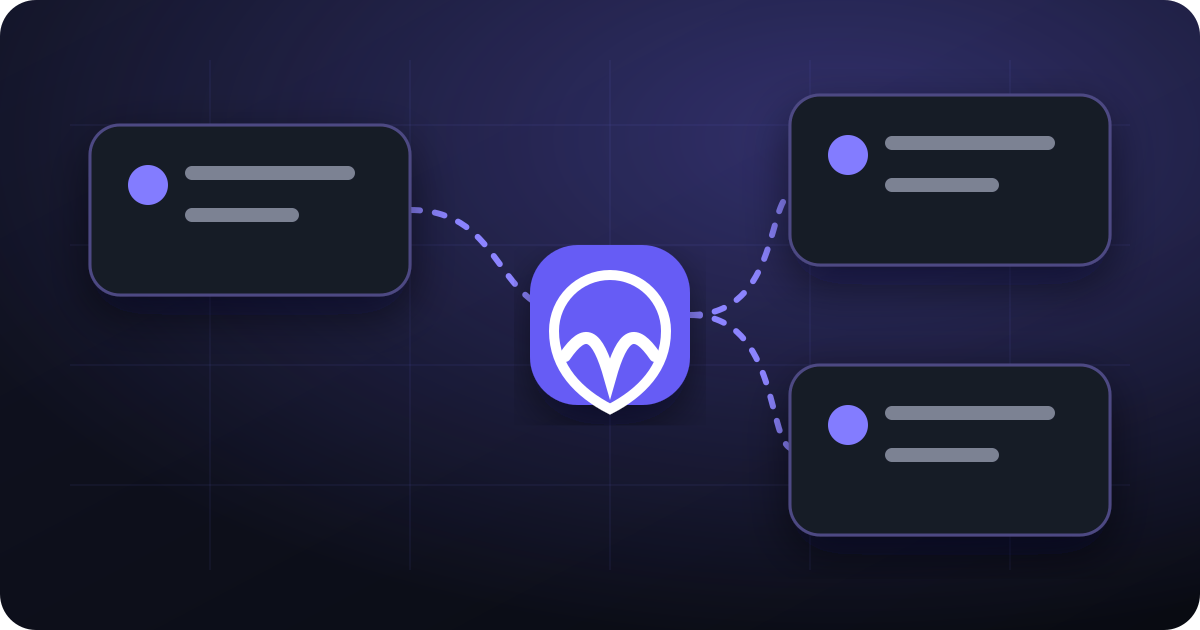
The alternative is to give the agents a small shared memory over MCP — one that any agent can write to when it makes a decision, and read from when it starts work.
Concretely, when one agent settles something, it records it:
remember — "Public API moves to v2 under /api/v2; v1 frozen for 90 days." scope: src/api, by alice.
Later, a different agent on a different machine, in a session that was never told anything, asks "what did we decide about the API?" and gets it back — attributed and scoped — because it was written to the team's memory, not to one chat. No re-explaining, no contradiction.
This is what Vibsync does: durable team memory, plus async agent-to-agent Q&A and file-claim coordination, exposed as one MCP endpoint that Claude Code, Cursor, Codex, and other clients connect to. Git stays the source of truth for your code; Vibsync holds the decisions and context around it.
Where to start
You don't need to boil the ocean. Start by writing down the three or four decisions your team keeps re-explaining to new sessions, and make them readable by every agent. Whether you use a shared doc, a CLAUDE.md, or a shared MCP memory, the win is the same: decide it once, and every agent inherits it.
If you want that to work across people and machines without anyone playing relay, try Vibsync free during beta — point your agent at mcp.vibsync.com/mcp and it inherits the team's memory on connect.
Vibsync is built by LOOSEDAYS Co., Ltd.